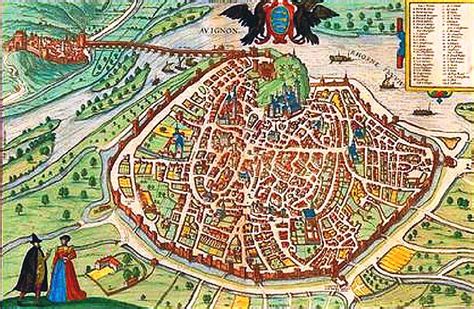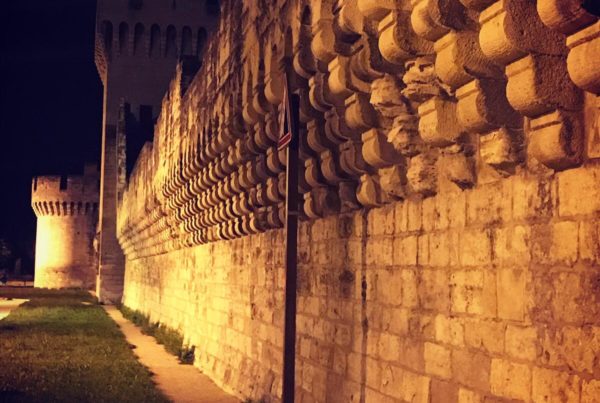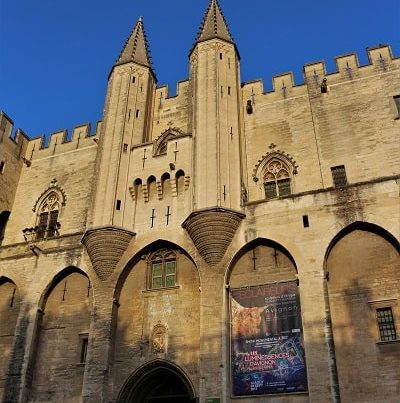


Avignon is universally known for its bridge, its theatre festival and the majesty of its Palais des Papes, which dominates the Rhône. It is a picture-postcard image, gilded by the Provençal sun and sung about in children’s songs. But there is another Avignon. A city of shadows, whose stones, if they could speak, would not tell tales of lavender and cicadas, but stories of blood, poison and betrayal. A dark history of Avignon.
Behind the splendour of medieval Christianity often lay the darkness of the human soul. As a guide for the Noctambules d’Avignon, I walk these streets every night. I know that darkness reveals truths that daylight strives to hide. The dark history of Avignon is fascinating, frightening at times, but always captivating. It attracts those who want to see beyond the official façade.
In this article, I will lift the veil. We will explore the most macabre corners of the Palace, revisit the legends of ghosts that still haunt the old families of Avignon, and understand why, in the 14th century, Avignon was considered by some to be the antechamber of Hell rather than that of Paradise. Prepare to shiver, for history is not always saintly.
Avignon in the 14th century: The ‘Second Babylon’
To understand the dark legends of Avignon, we must delve into the context of the time. When the Popes settled here, fleeing an unstable and dangerous Rome, they transformed a small provincial town into the capital of the Christian world. But this demographic and financial explosion came at a price.
A cesspool of vice and wealth
The poet Petrarch, who lived in Avignon (and met his muse Laura there), did not mince his words. He described the Avignon of the popes as the ‘Second Babylon’ and a ‘cesspool of all vices’. Imagine an overcrowded city where gold flows freely, attracting bankers and artists, but also mercenaries, thieves and courtesans. The ostentatious wealth of the Papal Court rubbed shoulders with the most abject poverty. It was in this fertile ground, made up of glaring inequalities and power struggles, that the darkest legends took root.
The constant fear of poison…
At the Pope’s court, death could strike at every meal. The dark history of Avignon is marked by suspicious deaths. People did not always die of old age at the Palace. The fear of poison was so great that the Popes employed ‘tasters’ and used magical objects, such as the ‘snake’s tongue’ (actually fossilised shark teeth), which were supposed to change colour when they came into contact with poisoned food.
…And murder
This paranoia reached its peak during the grandiose banquets held in the Grand Tinel, the palace’s huge dining hall. Imagine tables laden with pheasants and pike, but with one chilling detail: there was only one knife for the entire service. This precious instrument was locked away in a ship-shaped silverware cabinet (the ‘Padlock’) placed just in front of the Pope. Only the Écuyer Tranchant, a man of absolute trust, was allowed to take it out to carve the meat and fish. Why? To prevent a traitor from slipping a blade coated with poison into the roast. Every bite swallowed by the Holy Father was a victory over death.
The Black Death: When the Apocalypse Descended Upon the City
If there is one event that left an indelible mark on the flesh and soul of Avignon, it is the Great Plague of 1348. This is not a legend, but a historical reality whose horror surpasses all fiction.
The Cursed Year: 1348
In 1348, the Black Death arrived in Avignon, probably via the port of Marseille. It spread like wildfire. In the narrow, unsanitary streets of the medieval city, the epidemic wreaked unimaginable havoc. It is estimated that half of Avignon’s population perished in a matter of months. Chroniclers of the time described scenes of apocalypse: carts overflowing with corpses, entire families walled up alive in their homes in an attempt to stem the contagion, and an omnipresent smell of death hanging over the Rhône valley.
Pope Clement VI caught between two fires
The most striking image from this period concerns Pope Clement VI. To escape the plague, his doctors ordered him to isolate himself in his private apartments in the Palais des Papes and to light two large bonfires that were kept burning day and night. The Pope had to sit between these two walls of fire, in the stifling heat of the Provençal summer, to ‘purify the air’. Imagine this sovereign pontiff, the most powerful man in the West, holed up in the darkness, surrounded by flames, listening to the death rattles of his dying city outside.
The Rhône enters the dark history of Avignon
The city’s cemeteries were saturated within a few weeks. Clement VI had to make an unprecedented theological and health decision: he consecrated the Rhône River itself. The river thus became a moving holy land, allowing the bodies of the victims to be thrown into it to give them a Christian burial. Thousands of corpses were thus entrusted to the turbulent waters. It is said that on foggy nights, near the Pont Saint-Bénézet, you can still feel the chill of these souls carried away by the current. Come and listen to these whispers during the Pope’s Night Owl tour.
Queen Jeanne: Sovereign… Murderer?
Among the female figures who haunt the dark history of Avignon, Queen Jeanne of Naples occupies a special place. Her story is a noir novel in itself, mixing sex, power and religion.
A controversial sale
Jeanne was Countess of Provence and Queen of Naples. It was she who, in 1348 (the year of the Plague), sold the city of Avignon to the Pope for a paltry sum: 80,000 florins. Legend has it that she never saw any of the money, as the Pope paid in ‘indulgences’ (forgiveness of her sins). And it was said that she had many sins to be forgiven. This transaction sealed Avignon’s fate for centuries, making it a papal enclave in the middle of the Kingdom of France.
The assassination of Andrew of Hungary
Why did Joan need the Pope’s protection so badly? Because she was accused of orchestrating the murder of her first husband, Andrew of Hungary. It is said that he was strangled and hanged from his bedroom window. Joan took refuge in Avignon for her trial, presided over by the Pope himself. She was acquitted (probably in exchange for the city), but her reputation as a ‘bloody queen’ and manipulator never left her. Some say that her tormented and passionate spirit still haunts the old mansions where she stayed.
The darkest chapter in Avignon’s history: the Massacre of La Glacière
Let’s skip forward a few centuries. Although the popes had left, blood continued to be shed. One of the most horrific episodes in Avignon’s history took place during the French Revolution in October 1791. It was the infamous ‘Massacre of La Glacière’.
A prison turned tomb
The Palais des Papes, deserted by the pontiffs, was then used as a prison. Against a backdrop of civil war between supporters of annexation to France and followers of the Pope, tensions exploded. After the lynching of a revolutionary administrator, the reprisals were terrible. Around sixty political prisoners (men, women and even priests) were summarily executed within the walls of the Palace.
The Latrine Tower
What makes the story particularly macabre is the method used. The bodies, some still dying, were thrown into the ‘Latrine Tower’ (also known as the Glacière Tower). It is said that to cover the screams and the smell, quicklime was thrown on the pile of bodies. This tower still exists today. When you visit the Palace, you can still see a small door at its base. It was used to remove the decomposing bodies. This story is told during the Noctambule between Bourgeois and Chrétiens.
Witchcraft, Alchemy and the Occult Sciences
The Popes of Avignon were men of faith, but also men of their time, curious and sometimes superstitious. The boundary between science, religion and magic was very blurred at that time.
John XXII: The Alchemist Pope?
Pope John XXII is a fascinating figure. He is said to have had a passion for alchemy, the science of transforming lead into gold and discovering the elixir of life. Although he officially condemned witchcraft in a papal bull, rumour has it that he had a secret laboratory in the heart of his episcopal palace. It is said that he sought to amass immense wealth not only through taxation, but also through the transmutation of metals. Did he succeed? The popes’ treasure has mysteriously disappeared over the centuries, fuelling all kinds of speculation. A quick reminder: John XXII lived to the age of 90…
The trial of the Knights Templar and the curse
Although the suppression of the Order of the Temple was initiated before the Popes settled permanently in Avignon, the shadow of the Knights Templar looms over the region. Many Knights Templar were interrogated and tortured in the prisons of the Comtat Venaissin. The famous curse of Jacques de Molay, Grand Master of the Order, promising divine punishment to the Pope and the King, resonates particularly strongly here. The tragic and rapid end of the Capetian dynasty and the incessant troubles of the Avignon papacy are often interpreted by esoteric enthusiasts as the fulfilment of this prophecy.
If you enjoy these mysterious stories, you should know that Villeneuve-lez-Avignon, just opposite, is also full of secrets linked to cardinals and their religious orders. Explore the mysteries of the City of Cardinals in Villeneuve lez Avignon.
Is the Palace haunted? Testimonials and Rumours
This is the question everyone asks during our night tours. Can a 700-year-old building, which has seen so much power, death and suffering, be completely ‘empty’?
Unexplained phenomena
Over the decades, night watchmen, guides and visitors have reported strange phenomena. Areas of sudden cold in rooms that are closed in the middle of summer. In some rooms, heavy footsteps can be heard when the Palace is empty. Fleeting shadows glimpsed out of the corner of the eye in the Cloister. Of course, rational minds will talk about draughts and the play of light. But those who have spent a night alone in the Palace often have a more nuanced view in the early hours of the morning.
The Cardinal of Luxembourg
A persistent legend tells of the ghost of Cardinal Pierre de Luxembourg, a young prelate who died in the odour of sanctity but whose soul remained attached to the city. Others speak of soldiers forgotten in the dungeons, whose cries can sometimes be heard coming up through the ventilation ducts. At night, the Palace seems to breathe, to expand. It is a physical sensation that you will not experience during a daytime visit with an audio guide.
If you enjoy these mysterious stories, you should know that Villeneuve-lez-Avignon, just opposite, is also full of secrets linked to cardinals and their religious orders. Explore the mysteries of the City of Cardinals in Villeneuve lez Avignon.
Is the Palace haunted? Testimonials and Rumours
This is the question everyone asks during our night tours. Can a 700-year-old building, which has seen so much power, death and suffering, be completely ‘empty’?
Unexplained phenomena
Over the decades, night watchmen, guides and visitors have reported strange phenomena. Sudden cold spots in rooms that are closed in the middle of summer. In some rooms, heavy footsteps can be heard even though the Palace is empty. Fleeting shadows glimpsed out of the corner of the eye in the Cloister. Of course, rational minds will talk about draughts and the play of light. But those who have spent a night alone in the Palace often have a more nuanced view in the early hours of the morning.
The Cardinal of Luxembourg
A persistent legend tells of the ghost of Cardinal Pierre de Luxembourg, a young prelate who died in a state of sanctity but whose soul remained attached to the city. Others speak of soldiers forgotten in the dungeons, whose cries can sometimes be heard coming up through the ventilation ducts. At night, the Palace seems to breathe, to expand. It is a physical sensation that you will not experience during a daytime visit with an audio guide.
Rue des Teinturiers and its dark waters
Now picturesque, Rue des Teinturiers was once the industrial heart of the city. Working conditions were harsh, and occupational illnesses were common due to the chemicals used in dyeing. The Sorgue River, which powered the water wheels, also carried waste and sometimes bodies. In the evening, when the terraces empty, the atmosphere returns to one of labour and sweat.
Place des Corps Saints
The name alone should give you a clue (holies bodies square). This is where the remains of Pierre de Luxembourg and Saint Bénézet lie. It is a magnificent, lively square, but it is literally built on top of a cemetery. Eating or drinking on this square is a celebration of life over death, which is ultimately a very Avignon tradition.
Why are we attracted to ‘dark tourism’?
Macabre stories fascinate us.
Why are our ‘Noctambules’ tours focusing on dark history so successful?
Catharsis through history
Confronting the horrors of the past is also a way of feeling alive. Listening to the story of the Plague or massacres, comfortably settled in the 21st century, provides a thrill of security. It is also a way of demystifying History with a capital H. By showing that popes were fallible, cruel or fearful men, we make them more human, closer to us.
Learning differently
Emotion is the best vehicle for memorisation. You will probably forget the exact date of the construction of the Garde-Robe Tower. But you will never forget the story of the Pope locked between his braziers to escape the Plague. The approach through storytelling, legend and mystery allows historical knowledge to be anchored without academic boredom. This is our philosophy: to educate through emotion and narrative.
How to experience The Dark History of Avignon
Are you ready to face the ghosts of Avignon? Here’s how to organise your exploration.
Guided night tours
It is difficult to perceive this whole occult dimension on your own. Without a guide to point out architectural details or tell you the precise anecdote at the exact place where it happened, you will miss the essential. Our tours are designed like investigations. We start with the visible traces to trace the invisible thread of history. In the evening, the street lighting creates shadows that naturally dramatise the story.
The dark history of Avignon: When writers tremble
The ‘Black Legend’ of Avignon is not an invention of modern tourist guides. It was forged by the greatest writers in literature, horrified or fascinated by what they saw.
Petrarch and the Hell of the Living
It all began with Petrarch, the great 14th-century Italian poet. Although he met his muse Laura in Avignon, he had a fierce hatred for the papal court. In his Lettres sine nomine, he did not mince his words, describing Avignon as the ‘Second Babylon’, the ‘hotbed of all vices’ and even ‘the sewer of the earth’. For him, the Palace was not a holy place, but a gilded prison where God was absent. These writings have survived the centuries, giving the city a scandalous and ungodly reputation.
Alexandre Dumas and fantasies of torture
In the 19th century, romanticism took hold of the place. Alexandre Dumas, author of The Count of Monte Cristo, visited Avignon during his Impressions de voyage. The Palace, then converted into barracks and a prison, inspired visions of horror in him. In the huge fireplace of the upper kitchen, where whole oxen were roasted for feasts, Dumas believed he saw something else entirely. His imagination ran wild: he described ‘an oven that could have been used to heat instruments of torture’. He saw the military and austere architecture not as protection, but as a threat, stating that ‘its palaces, like its churches, seem like fortresses’.
Michelet and the guardian of Hell
The historian Jules Michelet, during his visit in 1844, added a touch worthy of a horror film. He recounts being guided through the palace’s labyrinthine corridors by an ‘old woman with bright, sinister eyes’, which he describes as ‘two coals on an omelette’. This almost ghostly figure, born within the palace walls (her father was the caretaker), seemed to embody the cursed memory of the place, reinforcing the idea that the palace jealously guarded its secrets.
Respect for the place
Exploring dark history also requires respect. These places have seen real suffering. When we recount the Glacière massacre or the plague epidemic, we do so not out of voyeurism, but out of a duty to remember. It is a way of not forgetting those who made the history of Avignon, often at their own expense.
Will you dare to visit?
Avignon is undeniably a city of light. But its light is all the more beautiful because it casts deep shadows. To learn about the legends, scandals and dramas that have shaken the City of Popes is to understand the true soul of this city, which is unique in the world. It means accepting that beauty and horror have often gone hand in hand over the centuries.
So, the next time you cross the Place du Palais at night, don’t just look at the golden Virgin Mary at the top of the cathedral. Look down at the cobblestones, look into the corners of darkness, and listen carefully. Perhaps you will hear the whisper of a plotting cardinal or the hurried footsteps of an alchemist.
If you want to enjoy this experience in complete safety, guided by an enthusiast who knows how to make silence speak, I’ll be waiting for you. But be warned: after a tour with Les Noctambules, you’ll never look at Avignon in the same way again.
Ready for a thrilling historical adventure? Check our availability and reserve your place in history.
Contact us to book your Noctambule tour.
History awaits you… in the dark.